In time, this may produce the tragic consequence of fewer communists--I mean professors--lounging away on tenure and spouting PC garbage. A few of their fellow fifth column buddies in the sprawling higher-ed bureaucracy might also find the end of the road. It may even come to pass in a generation or two that the only remaining campuses in America will be those focused on science and engineering, which require physical labs, or the truly elite schools, which can afford the outrageous expense.
Wednesday, January 30, 2013

Friday, January 18, 2013
Rhetoric or Realism?
Herewith a chart of black-white IQ differences by standard deviation and year. The over 18 line is more reliable, ranging from .95 to 1.2. The avg difference looks to be about 1.1 (ie, 83 IQ for blacks). Note the green line is lower--blacks fall further behind as they get older. Also, the data reveals not a single case of black adults scoring higher than 88 IQ.
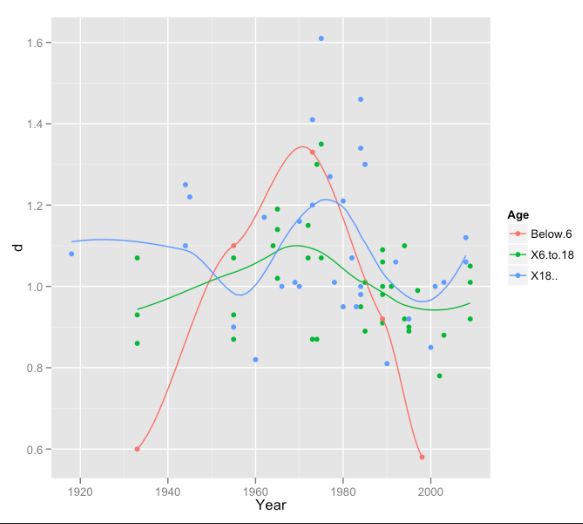
The lack of improvement despite extreme left-wing efforts ought to be discouraging--but that's the saving grace of idealism: reality may be set at nought so that the rainbow dream may shine on. Africans need some Chinese medicine (cough, eugenics, cough cough).
Die Uber-Chinese
Leftism is the flight from reality.
Reality may take many forms.
China has undertaken to provide us with our mandatory reality dose in this century.
Imagine if Nazi Germany had been run by Heydrich (relatively sane and smart) instead of Hitler (who squandered his potential) and its natural ethnic territory had been the size of America. This approximates the threat China will pose within a generation.
Leftism only knows one direction and ever intensified leftism either collapses in on itself--or those powers still in possession of their will to power crush its hollowed-out carcass and institute a new dispensation.
Thursday, January 17, 2013
Murder as It is Caused
http://www.nationalreview.com/articles/337929/war-against-black-men-lee-habeeb
If the "real cause" of murders is fatherlessness, why do blacks commit 8-10 times as many murders per capita as whites? After all, the black rate of fatherless boys is only twice the white rate. I think one of the largest causes is indeed fatherlessness, if one includes all the factors associated with that condition, including the high rate of criminality and unemployment among absconded fathers. However, it's notable that IQ is low and violence is high wherever one finds (free) blacks. Of course, blacks in mostly gunless Europe do less damage, but their violent propensities are well attested. Under Jim Crow, the problem was much reduced by economically-induced sustenance of black family integrity and by a degree of intimidation that was mainly salutary to all concerned.
Reminds me of a recent Steve Sailer note (check out the map, it covers the whole country):
Next door neighbors: Oak Park and Austin
The Austin neighborhood on the far west side of Chicago and Oak Park, IL are contiguous neighbors. The border is the yellow stripe in the middle of Austin Boulevard.
According to this NYT map (http://projects.nytimes.com/census/2010/explorer) of homicides in Chicago neighborhoods over the last 12 years:
Austin: More than 450 homicides have happened in this neighborhood in Chicago’s West Side, one of the city’s deadliest places
In contrast, over the last dozen years in Oak Park, which has about half as many people as Austin, there have been six murders.
It must be the lack of gun control laws in Chicago.
Tuesday, January 1, 2013
America's Economic Inflection Point?
The most informative are the graphs for:
declining real median incomes
healthcare costs driving deficits
social security benefits growing faster than incomes
Note that last one: social security benefits have tracked inflation since 2000, but median incomes have declined 9%. Is it possible that the year 2000 was the American equivalent of the year 1970 in Soviet history--the time when stagnation and decline set in? We still have a trickle of productivity growth, but it all goes to the rich, the welfare class (including the largest welfare class, old people), and the health care sector. The remainder of the economy languishes. And the politicos and propagandists continue to spout their politically correct lies (also reminiscent of the old Muscovite empire's Orwellian inversions and concealments).
Monday, December 31, 2012
The Left Unleashed--Moldbug Seeks Redress
The mad genius of the alt-right thinkers (Mencius Moldbug of Unqualified Reservations) nominates the American ruling class "The Cathedral." It comprises, by order of rank, the professoriate of the elite universities, the civil service (including our life-tenured Congress and Supreme Court), the media, the entertainment industry, and public school teachers. The op-ed linked above, by a law professor at an elite law school, is convoluted almost to the point of contradiction and stands as an absolute paean to the current Cathedral--truly one of the dumbest articles, substantively, I've seen at the NY Times. Also, not coincidentally, one of purest ideologically, that is, one of the most brilliant in terms of form and structure--which is impressive, since editorial writers, especially on the left, are primarily engaged in a status game in which the purest theologically, I mean, ideologically wins the prize. This game can be rather creative given that there are no rules proscribing flights of fantasy or violations of the reality principle. The overarching stupidity here, of course, is that he advocates freedom from the constitution in the same article in which he (accurately) boasts that we have frequently, and by implication ever more frequently, violated its provisions throughout our history. I also like the strategic omission of any mention of the provision made for amending the Constitution, a provision many times put to use. It might be interesting, though, to attempt an aesthetic appreciation of this piece, exemplary decadent art object that it is.
As a counterstrike to this Leftist insanity, here's a good intro to Moldbuggian thought: http://unqualified-reservations.blogspot.com/2009/01/gentle-introduction-to-unqualified.html And here are my selections from the highly interesting Moldbug on the nature of the Cathedral and his mission to proselytize the shepherds (the boldface is mine):
One way to elect a new people is to import them, of course. For example, to put it bluntly, the Democratic Party has captured California, once a Republican stronghold, by importing arbitrary numbers of Mexicans. Indeed the Third World is stocked with literally billions of potential Democrats, just waiting to come to America so that Washington can buy their votes. Inner Party functionaries cackle gleefully over this achievement. (BTW, isn't that photo of Frank Rich amazing? Doesn't it just radiate pure power and contempt? Henry VIII would probably have asked the painter to make him look less like Xerxes, King of Kings.)
But this act of brutal Machiavellian thug politics, larded as usual with the most gushing of sentimental platitudes, is picayune next to the ordinary practice of democratic governments: to elect a new people by re-educating the children of the old. In the long run, power in a democracy belongs to its information organs: the press, the schools, and most of all the universities, who mint the thoughts that the others plant. For simplicity, we have dubbed this complex the Cathedral.
The Cathedral is a feedback loop. It has no center, no master planners. Everyone, even the Sulzbergers, is replaceable. In a democracy, mass opinion creates power. Power diverts funds to the manufacturers of opinion, who manufacture more, etc. Not a terribly complicated cycle.
This feedback loop generates a playing field on which the most competitive ideas are not those which best correspond to reality, but those which produce the strongest feedback. The Cathedral is constantly electing a new people who (a) support the Cathedral more and more, and (b) support a political system which makes the Cathedral stronger and stronger.
For example, libertarian policies are not competitive in the Cathedral, because libertarianism minimizes employment for public-policy experts. Thus we would expect libertarians to come in two flavors: the intellectually marginalized, and the intellectually compromised...
What we need is a sort of counter-Cathedral: an institution which is actually more trustworthy than the university system. The universities are the brain of USG, and the best way to kill anything is to shoot it in the head.
To be right when the Cathedral is wrong is to demonstrate that we live under a system of government which is bound together by the same glue that held up Communism: lies. You do not need a triple-digit IQ to know that a regime held up by lies is doomed. You also do not need a triple-digit IQ to help bring down a doomed regime. Everyone will volunteer for that job. It's as much fun as anything in the world.
To be right when the Cathedral is wrong is to demonstrate that we live under a system of government which is bound together by the same glue that held up Communism: lies. You do not need a triple-digit IQ to know that a regime held up by lies is doomed. You also do not need a triple-digit IQ to help bring down a doomed regime. Everyone will volunteer for that job. It's as much fun as anything in the world.
Solely for the purpose of discussion, let's call this counter-Cathedral Resartus - from Carlyle's great novel, Sartor Resartus (The Tailor Reclothed).
The thesis of Resartus is that the marketplace of ideas, free and blossoming as it may seem, is or at least may be infected with lies. These lies all have one thing in common: they are related to the policies of modern democratic governments. Misinformation justifies misgovernment; misgovernment subsidizes misinformation. This is our feedback loop.
On the other hand, it's clear that modern democratic governments are doing many things right. Perhaps in all circumstances they are doing the best they can. Perhaps there is no misinformation at all. The hypothesis that such feedback loops can form is not a demonstration that they exist.
Therefore, the mission of Resartus is to establish, using that crowdsourced wiki-power we are all familiar with, the truth on every dubious subject. Perhaps the truth will turn out to be the official story, in which case we can be happy.
The two sites today which are most like Resartus are Climate Audit and Gene Expression. Both of these are, in my humble opinion, scientific milestones. CA's subject is climatology; GNXP's subject is human biodiversity.
Tuesday, December 18, 2012
Review of The Specter of Communism
The Specter of Communism by Melvyn Leffler
This is a brief book on the origins of the Cold War, slanted politically two ways: in its omission of information that undermines the author’s Soviet sympathies
and in chastising the Americans for not making the most flattering assumptions
about Soviet intentions. Leffler barely mentions, for instance, the pervasive
network of Soviet agents throughout American and British government agencies from
the 30s on (see the Venona Project). This gave Stalin knowledge of Western
plans and strengthened his negotiating position. It also gave him major
information on the fission and thermonuclear bombs. Then he fails to mention
that the Anglo-American allies permitted the Soviets uncontested access to the
Balkans during WWII, despite Churchill’s insistence that the Soviets would
impose totalitarian governance on the region postwar. He fails to notice that
FDR had intended a joint American-Soviet invasion and occupation of Japan
(which would have been strategically disastrous postwar). Leffler ignores the
consistently weak hand the Anglo-Americans (i.e., the spy-infested, communist
sympathizing Roosevelt administration) played in its dealings with Stalin. Roosevelt
is guilty of the terrible folly of presuming moral equivalence between America
and the USSR. This presumption led to his belief in fair play with Stalin, a
concept utterly alien to that master of realpolitik. Leffler, though, thinks
Roosevelt’s approach to Stalin was “shrewd and pragmatic”—an apt description only
of Stalin’s management of Roosevelt. Remember, Roosevelt did not demur when
Stalin demanded Soviet assimilation of the lands Hitler ceded to him under the
1939 Nazi-Soviet Pact—a massive concession that condemned many millions to
virtual enslavement.
Leffler faults Truman for taking defensive measures in
Europe, instead of continuing down the Roosevelt path of incremental
surrender. He accuses Truman of
focusing on “the Kremlin’s ominous [postwar] conduct and overlook[ing] signs
of Soviet moderation.” He defines moderation here as meaning that Stalin did
not conquer new lands at every possible opportunity, but contained himself to
submitting only 8 or 10 nations. How is this moderation? Essentially, Leffler
wants to excuse all of these Soviet aggressions based on the toll the Soviets
had suffered in WWII. Yet, why is this cause that Lithuania or Estonia should
cease to exist, that Poland should lose territory and have its people removed
to the West, that N. Korea should submit to a puppet communist regime? Stalin,
Machiavelli’s best student, took what he believed could be had without a fight
(with his spies indicating what America would fight for). Under Roosevelt, it
turned out he could get a great deal. Leffler credits Stalin’s moderation for
pulling out of Manchuria. But he only did so because he knew it was
strategically untenable—the Chinese would eventually fight to recover it, and
in the interim it upset the West.
At one point Leffler says of the Truman administration:
“U.S. officials were indifferent to the brutality and repression of Stalin’s
dictatorship at home so long as the Kremlin showed restraint abroad.” But, of
course, they were far from indifferent—otherwise the ideological dimension of
the Cold War would have disappeared. In fact, they were fatalistic, quite a
distinguishable perspective, and one largely to their credit. They had no
reason to believe they could effect regime change, or even the reform of a hostile
superpower. Need I mention yet another pro-communist omission by this Leffler
hack? China, perhaps a nation of some strategic consequence, went communist in
1949. The effective absence of U.S. aid to the non-communist forces goes
unmentioned. He does mention that Stalin aided Mao, but does not dare fault him
for it. Double standard? Nah. He merely blames Chiang Kai-shek’s incompetence,
then mocks the Republican party for criticizing Truman’s negligent China
policy.
He claims Truman in 1947, with the Marshall plan and the
Truman Doctrine, had moved “decisively to an adversarial relationship.” Yet,
the first was simply economic aid, which was also offered to the Soviets and
their substates. The second was a defensive understanding to help freely
elected governments resist armed insurrection. To call these measures, under
the circumstances, decisively adversarial appears a mischaracterization—is not the
insurrection itself, supported by outside communist states, the source of
animus? He cites Stalin’s fears that accepting American aid in the Soviet Union
and its sphere would have given the U.S. control over the Soviet economy: this
is absurd, but Leffler offers no reality check, implying it was a legitimate
fear. A few years of aid was no threat even in Eastern Europe, much less in the
Soviet Union. Stalin was simply consolidating his empire's ideological purity in the
postwar uncertainty. But, declining aid was a paranoid tactical misjudgement.
Another unmentioned asymmetry in superpower relations was the freedom of
communists in Western nations to form parties and pursue political power. In
Eastern Europe this was out of the question. Leffler does kindly notice that
American influence abroad was mainly a consequence of “persuasion, inducements,
and financial leverage,” implicitly in contrast to Soviet methods. The Berlin
blockade receives a straight retelling.
Leffler says that Truman “was willing to fight domestic
subversives.” Yet, he kept Harry Dexter White in a leading diplomatic position
for two years after the FBI had provided ample evidence that he was a spy.
Truman later lied about this, claiming that White was dismissed “promptly.” The
considerable damage White did is well-documented. The author does not mention
that Truman declined to take the obvious step of intensifying the investigation
Soviet espionage in America even after the Soviets tested the fission bomb
earlier than expected in 1949. Then Truman vetoed the McCarran Act, his
Secretary of State supported Alger Hiss after Hiss was convicted of lying about
spying for the Soviets, and he fired his vigorously anti-communist Defense
Secretary, Forrestal, for being unpopular with left-wing Democrats (Forrestal
died mysteriously a few weeks later).
In apologizing for Soviet connivance in the North Korean
attack, Leffler says “Truman and Acheson were unaware of the instrumental
effect Kim himself had played in initiating the conflict.” If Stalin and Mao
had not approved, it would not have happened. Kim had no effect; he was not instrumental, he was their
instrument; this was naked Soviet supported aggression to subjugate a
non-communist nation. Stalin is not faulted, of course. He just wanted a “buffer.”
They forced Truman’s hand, as Leffler notes: “If the Kremlin thought the Americans
would equivocate in a crisis, Moscow might be tempted to act more
adventuresomely.” The State Dept, already a leftist stronghold, warned against
even trying to free N. Korea—to stand unequivocal was one thing, after all, but
to actually believe in the American cause was past the capacity of State.
Truman was not sufficiently tamed, though, and set MacArther to take the
peninsula entire. The administration’s reluctance to use atomic bombs was
reasonable. They were willing to do so if the enemy significantly escalated,
also reasonable. Yet, given tremendous qualitative superiority in all respects
and quantitative superiority in terms of war production potential, the US could
have won decisively without the Bomb. The commitment was not made. Stalemate
resulted. I might add that even Eisenhower ducked his responsibilities by
signing the Korean armistice right after Stalin died, even though his death presumably weakened the
Soviet side.
Of McCarthy Leffler says he focused exclusively on looking
for spies, while ignoring foreign policy, though Leffler thinks “few of them actually
existed in the American government.” Contra Leffler, counterintelligence is foreign policy! And
to claim the Soviets were running only a few spies is demonstrably wrong at this point. The
number of communist sympathizers, moreover, at State and elsewhere, bears emphasis
as well. But, Leffler contends that “even more threatening to democratic
traditions and a free society [than the military-industrial complex] was the new
Red Scare.”So, then, unconsciousness of Soviet espionage was the better route—the
one which won us the victory of securing nuclear plans for the immaculate dear
leader Stalin? McCarthyism was a pathetically inadequate attempt to restore
political balance in America after a communist sympathizing four term President
and the domestically pro-socialist two term President who succeeded him.
Neither the Chief Executive nor the FBI did their jobs in these years. McCarthy’s
demagogy was crude and some of it misdirected, since he ought to have
concentrated on the federal government and nothing else. The American Left was
lucky that the pendulum swing was so weak and so late: they were able to hide their
revolutionary machinations for almost twenty years behind the Depression, the
World War, and the onset of the Cold War. They had transfomed America from a
democracy to a socialist democracy and prepared the ground for the bureaucratic
socialist oligarchy forthcoming. In his conclusion, Leffler claims that the
Americans “exaggerated the ability of the Soviets to capitalize on [postwar]
developments,” including those led by “revolutionary nationalist leaders” in
the third world—an absurd claim, motivated again by this Soviet apologist’s
urge to blame America first, a habit consistently evidenced in his book from
beginning to end.
Leffler does a better job on the conceptual level of
explaining the interactions of power and ideology in Cold War tensions. The
dynamic of the Cold War: the rivalry was one of ideology and power politics.
Power politics is always territorial, but in this case, since each ideology was
universalist, both elements of the rivalry urged territorial expansion. Thus,
Stalin wanted mastery over Eastern Europe to expand his geopolitical power and
to spread his ideology to new lands. And American influence over Western Europe
was also geopolitical and ideological. The two motivations usually overlapped,
though it might be argued the Soviets were more consistent in aligning the two.
American support for the Shah of Iran or the Afghan mujahideen were power
political plays, but contrary to our ideology. Even the Soviets, though, had
close ties with India, a quasi-capitalist democracy. Generally, when it came to a
choice, power politics proved more important to each side. The game of power politics never yet has
ceased, though it forms itself into a variety of configurations in different
times and places—in this case a bipolar configuration was inevitable. Before
the war it was multipolar, given the power of Germany, Japan, the UK, and
France. The ideological dimension has rarely approached the prominence of the
capitalist-communist opposition. Comparable to it, though, were wars arising
from the theological splits of Muslim-Christian, Muslim-Hindu,
Protestant-Catholic, and such like. As a final spur to make the security
dilemma inescapable, both powers in the Cold War believed they had to attain at
least equal global territorial power to ensure the long-term continuance of
their regimes. Neither could long survive international isolation.
Wednesday, December 12, 2012
Advantaging the Offense
First a commercially available drone aircraft for $1200, now this thing. Counterinsurgency looks like a less and less attractive career.
Sunday, December 9, 2012
Doing It Wrong
Bureaucracy is an animal that operates in the same inefficient, self-expansionary fashion whether it finds itself in an entitlement environment, a military environment, or a regulatory environment. In the instance here investigated, regardless of the stakes, quite content to ignore the lives lost and billions squandered, our military bureaucracy grinds on blindly and brutally, led by the madmen charged with our political fate.
Tuesday, December 4, 2012
Singapore's Path
This is what a country can do today when it is run like a business, allows immigrants in selectively, and does not encourage failure--also, when it ignores America's ruling class and its politically correct advice. Lee Kuan Yew even urges eugenics upon Singaporeans, and they believe in its advantages (though I'm not sure they act on it). And China's leaders are well acquainted with this model of development and governance. If they're willing and able to replicate it closely, they will so far surpass us that we'll be relegated to the pile of second rate powers with Japan, Indonesia, Germany, Brazil, Mexico, and a few others.
Subscribe to:
Posts (Atom)